When most people think about lifeguard training, they picture the initial certification course – the swim tests, CPR practice, and rescue scenarios. But in reality, that’s just the starting point. The true backbone of aquatic safety is in-service training: the ongoing, facility-specific practice that keeps lifeguards sharp, confident, and ready to act when seconds matter. Across national standards, state regulations, and leading training organizations, one message is clear – lifeguard skills are perishable, and continuous training is essential.
The Standard: What National Guidelines Expect
The Model Aquatic Health Code (MAHC), developed by the CDC, sets the tone for best practices in aquatic safety across the United States. It emphasizes that lifeguard training must be standardized, comprehensive, and include repeated hands-on skill practice. Importantly, MAHC highlights that lifeguards must regularly practice both in-water and out-of-water skills under qualified supervision.
This directly supports the need for in-service training. A one-time certification cannot realistically maintain proficiency in high-risk, low-frequency skills like spinal rescues or multi-victim response. Without repetition, response times slow and errors increase.
State-Level Expectations: Minnesota Health Code
At the state level, the Minnesota Department of Health reinforces similar expectations. While specific facility policies may vary, Minnesota requires properly trained lifeguards capable of preventing, recognizing, and responding to aquatic emergencies – skills that must be maintained over time, not just learned once. In practice, this means aquatic facilities across Minnesota rely heavily on in-service training to:
- Meet compliance expectations
- Document ongoing competency
- Reduce liability
Without consistent in-service sessions, even certified guards may fall short of the “ready-to-respond” standard expected by regulators.
The Red Cross Perspective: Skills Fade Without Practice
The American Red Cross – the most widely recognized lifeguard training provider in the U.S. – builds its entire program around the idea of continuous readiness. Red Cross training emphasizes that lifeguards must be able to prevent, recognize, and respond to emergencies, using skills like CPR, AED use, and water rescues. However, even their certification is only valid for two years, and recertification courses are designed specifically to refresh and reinforce skills that degrade over time. In-service training fills the gap between certification cycles by:
- Reinforcing surveillance and scanning techniques
- Practicing emergency action plans (EAPs)
- Building teamwork and communication under pressure
Without it, even well-trained lifeguards risk becoming passive observers instead of proactive safety professionals.
StarGuard Elite: A Model Built on Continuous Evaluation
Organizations like StarGuard Elite take the importance of in-service training even further. StarGuard Elite is known for its evidence-based training protocols and ongoing performance evaluation, supported by medical experts and real-world data. A key feature of their approach is continuous assessment – often including audits and frequent skill reviews.
This model reflects a critical truth: Lifeguarding is not just a certification – it’s a continuously practiced discipline. Facilities that adopt this philosophy tend to integrate structured, frequent in-service sessions as a core operational requirement, not an afterthought.
What You Might See RAC Lifeguards Practicing
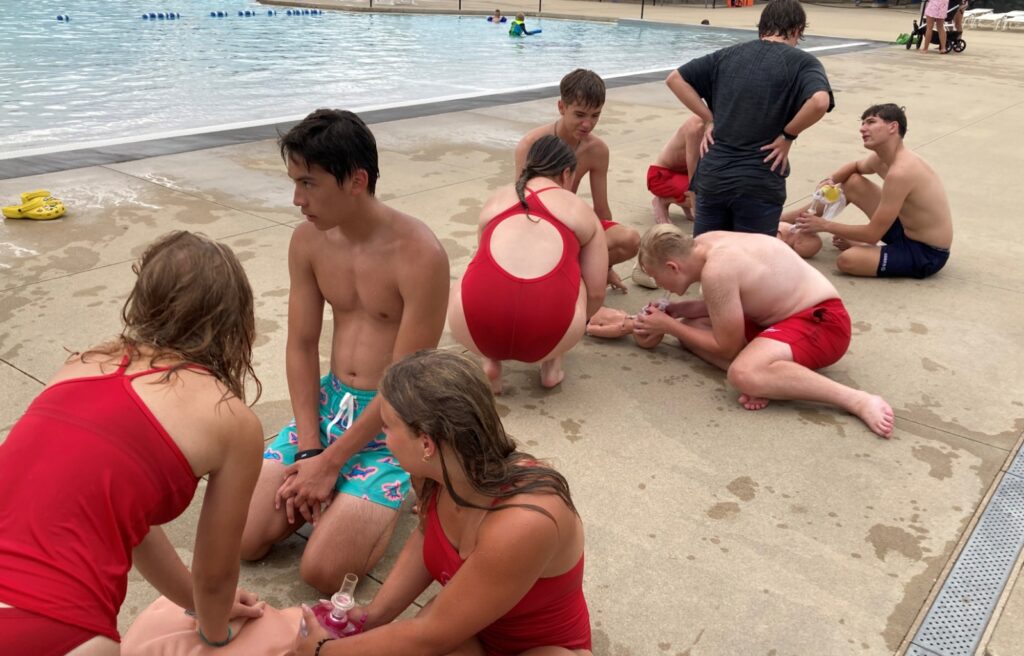
The Rochester Athletic Club uses both Red Cross and StarGuard Elite lifeguards for our staffing. We use a combination of manikins, actual people, silhouettes, and equipment to run in-service trainings on scanning, recognition and response, skills practice, and full training scenarios. This helps the lifeguards work as a team and keep specific skills proficient.
Why In-Service Training Matters in the Real World
Even the best training programs cannot replicate the unpredictability of real aquatic environments. In-service training bridges that gap by focusing on facility-specific risks and real-time performance. Key benefits include:
1. Skill Retention
Lifeguard skills – especially rescues and CPR – decline quickly without repetition. Regular drills keep responses automatic.
2. Faster Emergency Response
Practicing realistic scenarios improves reaction time and reduces hesitation during actual emergencies.
3. Stronger Team Coordination
Emergency action plans rely on teamwork. In-service training builds communication and role clarity.
4. Prevention-Focused Mindset
Ongoing training reinforces proactive scanning and hazard recognition, which are essential for preventing incidents before they occur.
5. Compliance and Risk Management
Consistent training helps facilities meet standards set by MAHC, state health codes, and insurance providers.
From Certification to Competence
Initial certification – whether through the American Red Cross or StarGuard Elite – provides the foundation. But in-service training is what transforms that foundation into real-world competence. A lifeguard who trains regularly:
- Scans more effectively
- Responds more confidently
- Communicates more clearly
- Saves lives more reliably
In contrast, a lifeguard who relies solely on past certification risks becoming out of practice – and in an emergency, that gap can be critical.
Final Thoughts
In-service training isn’t just a best practice – it’s a necessity. National standards like the Model Aquatic Health Code, state expectations in Minnesota, and leading organizations like the American Red Cross and StarGuard Elite all point to the same conclusion:
Lifeguarding is a Skill That Must Be Practiced, Not Just Learned.
For aquatic facilities, investing in consistent, high-quality in-service training isn’t just about compliance – it’s about creating a culture of safety where lifeguards are always prepared to act when it matters most.